Binding (of a religious book)
Christian, Monique, Paula. Degrigny, Drieux, Homem (ENDLESS Metal, Neuchâtel, Neuchâtel, Switzerland)
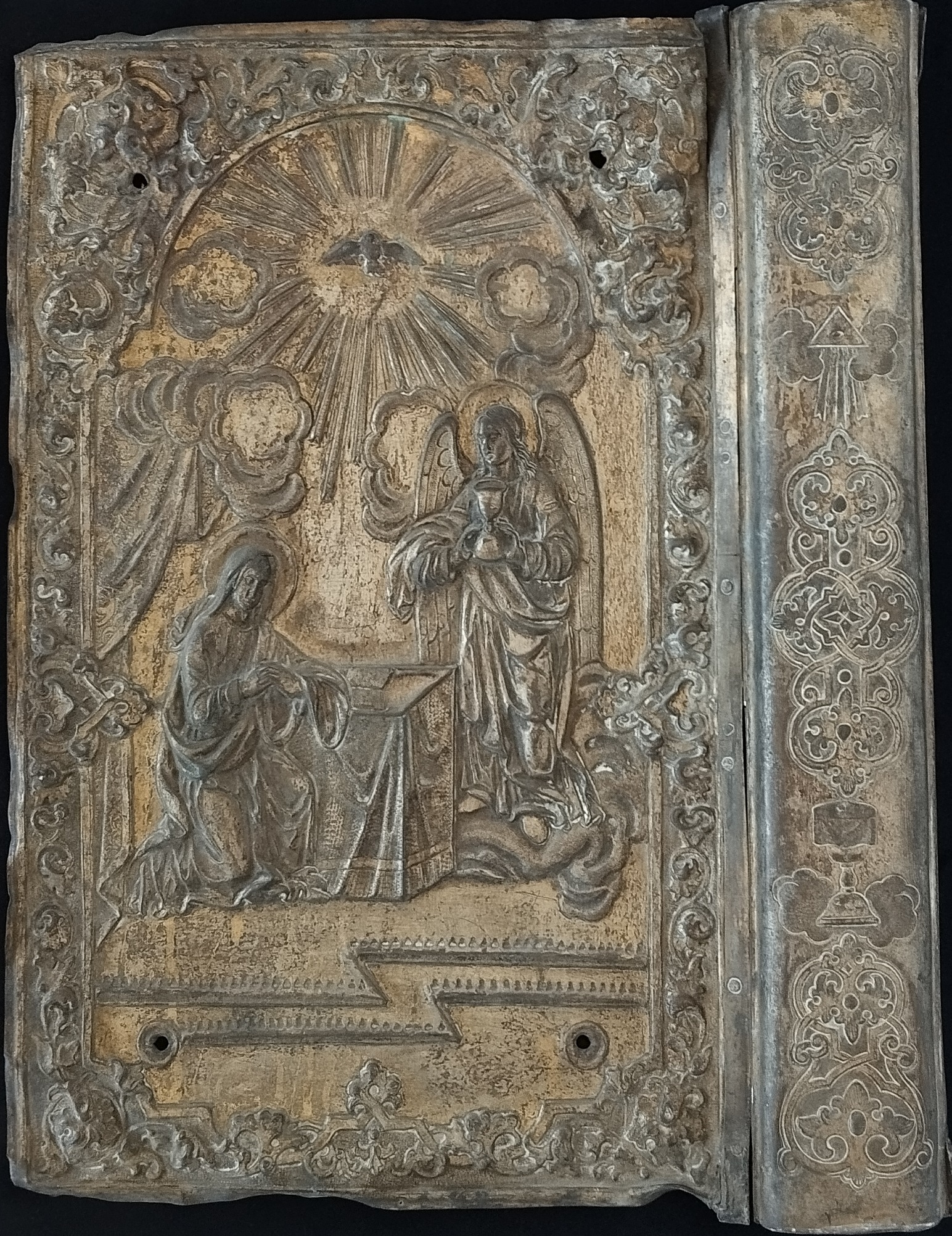
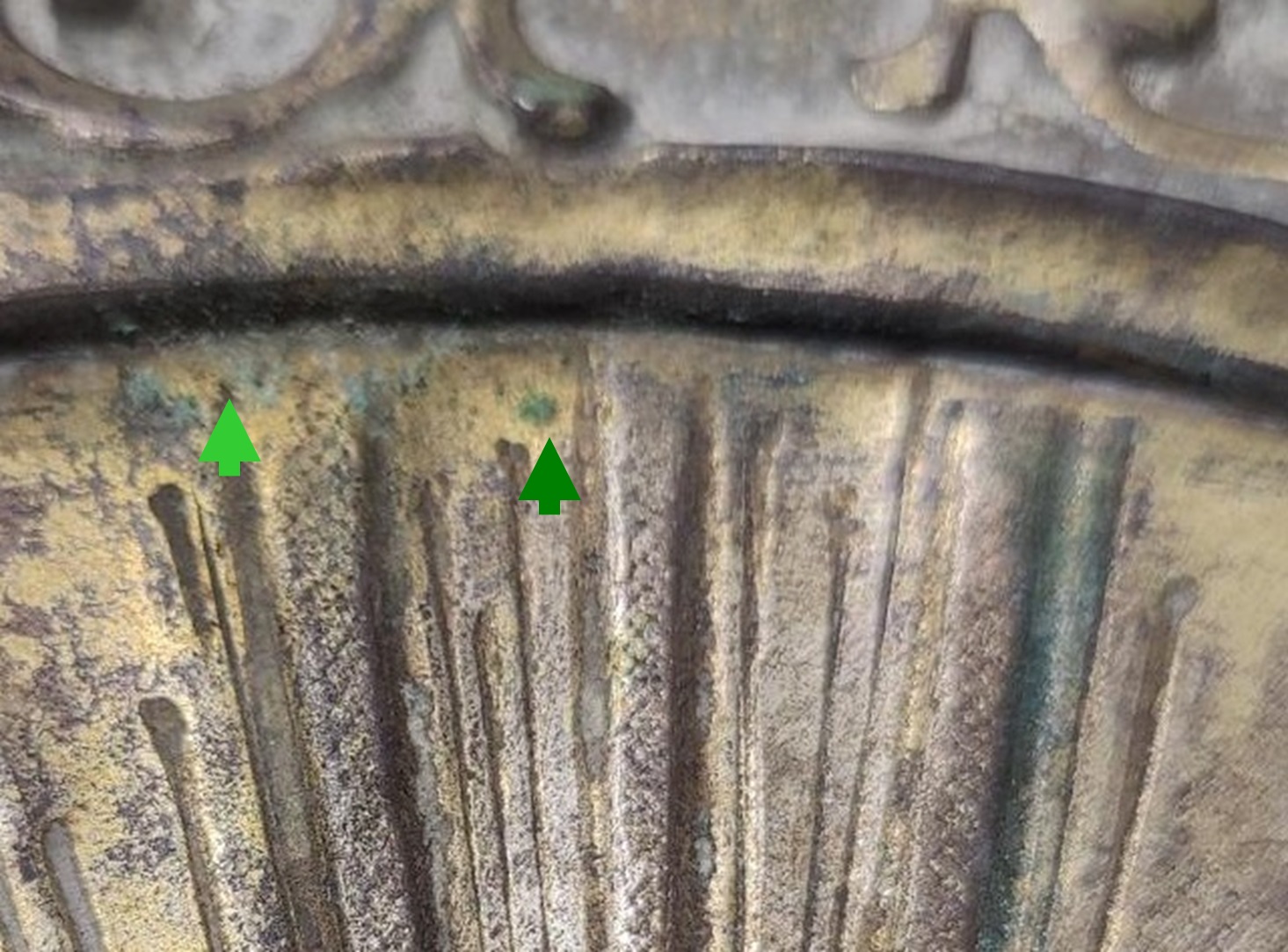
Back plate and spine of a binding (of a religious book) depicting the scene of the Annunciation. The metal sheets (fixed by rivets) are embossed and the back plate have four fixing holes. Deformed, locally torn, abraded on the reliefs, heavily tarnished but showing a yellowish metallic appearance and traces of greenish and whitish compounds in hollows.
Religious object
Museum collection of Timisoara diocese, Timişoara, Timiş, Romania
None
None
Indoor atmosphere
Museum collection of Timisoara diocese, Timişoara
Museum collection of Timisoara diocese, Timişoara
TMSC.DECK 001
No record but evidence of cleaning residues
None.
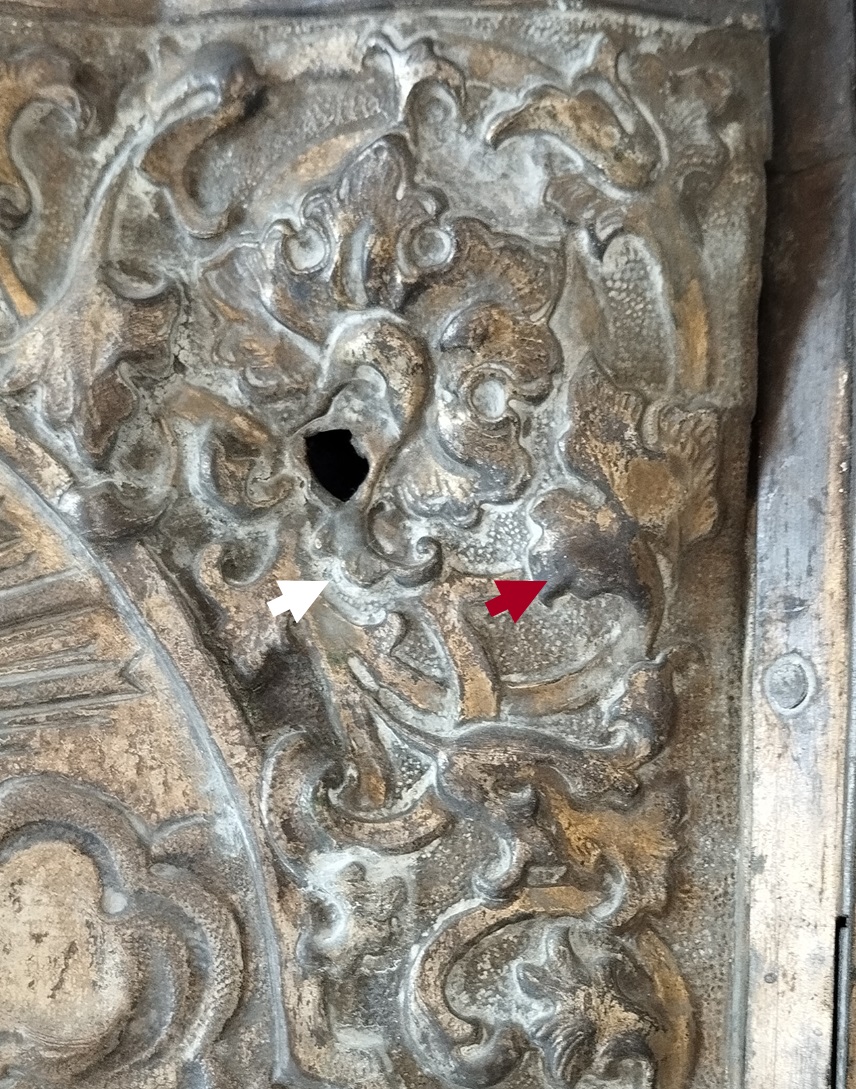 Credit HE-Arc CR, C.Degrigny
 Credit HE-Arc CR, C.Degrigny
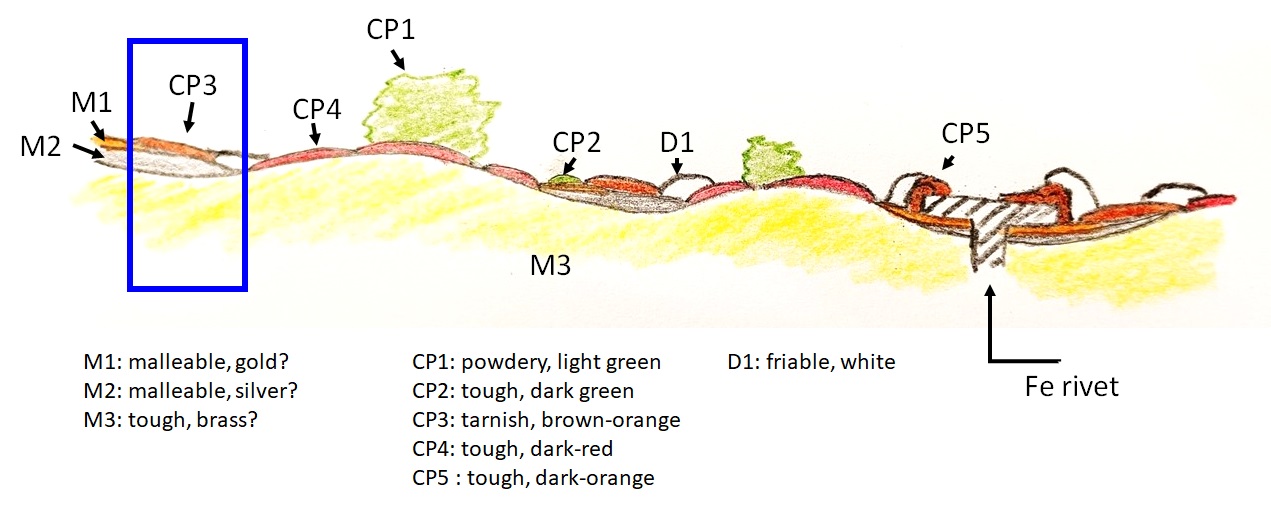
The schematic representation below gives an overview of the corrosion structure(s) encountered on the back side of the binding from a first visual macroscopic observation.
None
None
None
None
None.
Analyses performed:
Non-invasive approach
XRF with handheld portable X-ray fluorescence spectrometer (Bruker Tracer® 5i). Alloys 2 mode, acquisition time 30s.
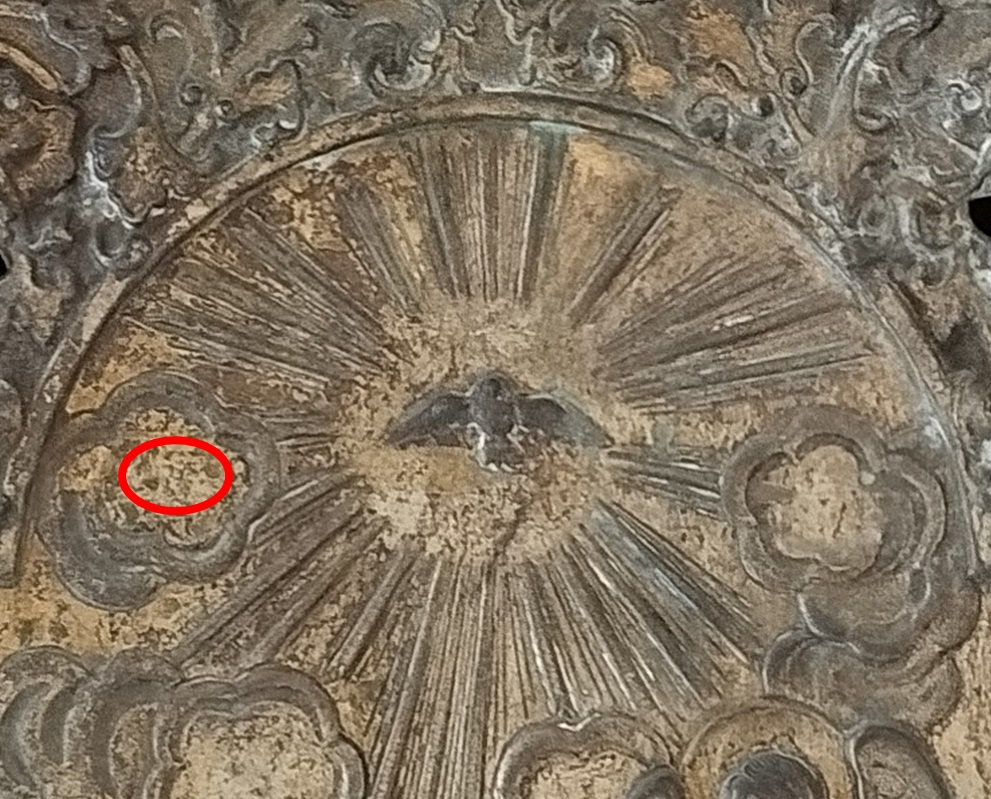
XRF analysis of the back side of the binding was carried out on one representative area (Fig. 4).
Results of the area observed indicate that the metal sheets are made of brass. The presence of Ag and Au seems to validate the hypothesis made in Fig. 5 and represented on the stratigraphy of Fig. 6.
| Elements (mass %) | Cu | Zn | Ag | Au | Si | Al | Mg | S | ||||||||
| % |
+/-2σ |
% | +/-2σ | % | +/-2σ | % | +/-2σ | % | +/-2σ | % | +/-2σ | % | +/-2σ | % | +/-2σ | |
| 1 | 54 | 0.3 | 29 | 0.2 | 3 | 0.1 | 2 | 0.1 | 7 | 0.2 | 3 | 0.5 | 2 | 0.5 | 1.5 | 0.04 |
Table 2: Chemical composition of the surface of the back side of the binding at one representative point shown in Fig. 4. Method of analysis: XRF, National Museum of Banat, Timisoara, Romania.
As mentioned in the previous paragraph, the metal sheets are made of brass which has been silvered and then gilded. There is not enough information to determine whether they have been fully or partially coated.
None
Cu
Zn, Ag, Au
None.
As mentioned before, the metal surface is heavily tarnished. Greenish compounds can be found locally, while and whitish compounds are usually found in hollows.
Passive
Silver tarnishing
None.
None.
The back plate and spine of the binding are made of brass sheets, silvered and gilded. They are heavily tarnished and it is supposed greenish and whitish compounds in hollows.